Skip to content
ZionNationalPark.com logo

Getting Around

Important Zion National Park Update

The historic Zion–Mount Carmel Highway and Tunnel will be closed to all large vehicles on June 7, 2026. 

The Zion–Mount Carmel Highway has been welcoming visitors since 1930, when cars were a bit smaller, and the drive was meant to feel scenic, not stressful. Because the road, tunnel, and historic bridges were built for vehicles of that era, safety studies in 1989 and 2019 confirmed that today’s larger vehicles can’t pass through safely without crossing into oncoming traffic or exceeding weight limits. These size restrictions protect visitors and this historic roadway while improving traffic flow for all visitors. 

Fact: In 2016, oversized vehicles brought traffic to a standstill for 41 minutes of every hour.

Take steps to prepare for your trip by measuring your vehicle BEFORE arrival. Remember to include mirrors, tires, and ALL attachments (AC units, bike racks, satellite dishes, roof racks, after-market modifications).

If your large vehicle exceeds limits, you will not be able to travel through the tunnel and will need to turn around at Canyon Junction or the East Entrance. 

Large vehicles CAN still access the park if:

  • Parking in a large vehicle lot at Zion Canyon Visitor Center (limited space available)
  • Have Zion Lodge pass
  • Driving Zion Canyon Scenic Drive during the shuttle off-season
  • Camping at Watchman or South Campground

If your vehicle or trailer is too large, this is an opportunity to refresh your itinerary by taking an alternative scenic route to Zion National Park with exciting stops.  


Getting to Zion National Park

Zion National Park is in southwest Utah along State Route 9, with its most popular south entrance near Springdale, UT. This entrance houses the Zion Canyon Visitor Center, where shuttle service, trailheads, and park information are located. Getting to the park by plane, shuttle, RV, or car is a breeze. 

Flying

St. George Regional Airport  (SGU) is the closest airport, only 45 minutes from the park. Daily flights connect directly to major hubs in

  • Salt Lake City (SLC) – Delta
  • Denver (DEN) – United Airlines
  • Los Angeles (LAX) – United Airlines
  • Phoenix (PHX) – American Airlines
  • Dallas-Fort Worth (DFW) – American Airlines

Seasonal Destination(s):

  • Chicago (ORD) – United Airlines (operates May through August)

Alternatively, Harry Reid International Airport in Las Vegas (LAS) offers a wide array of flights, as does Salt Lake City International Airport (SLC). From these airports, you can rent a car or take shuttle services to Greater Zion. 

More Information

Driving

Drivers and road-trippers can reach the breathtaking landscapes of Zion National Park faster than you might expect. Interstate 15 and Interstate 70 provide convenient connections from across the United States.

  • From the north/south: Take State Route 9 through Springdale.
  • From the east: The Zion‑Mount Carmel Highway (SR‑9) connects Zion National Park to I‑15 and scenic areas beyond. Large vehicle size restrictions apply. Beginning June 7, 2026, no large vehicles will be permitted on the highway. For more information, click here. 

If you’re staying in Springdale, you can hop on the free town shuttle or simply walk or bike through the pedestrian entrance to the park. 

The pedestrian entrance is the easiest way to enter the park. Follow the bridge that crosses over the Virgin River to the entry gate, where you will pay the pedestrian entrance fee (which is cheaper than the private vehicle fee), walk in, and find yourself only a few feet away from the Zion Canyon Visitor Center and first shuttle stop in the park. 

Visitors staying elsewhere in Greater Zion can reach the park with a short drive or via the SunTran Zion Route.

Shuttling

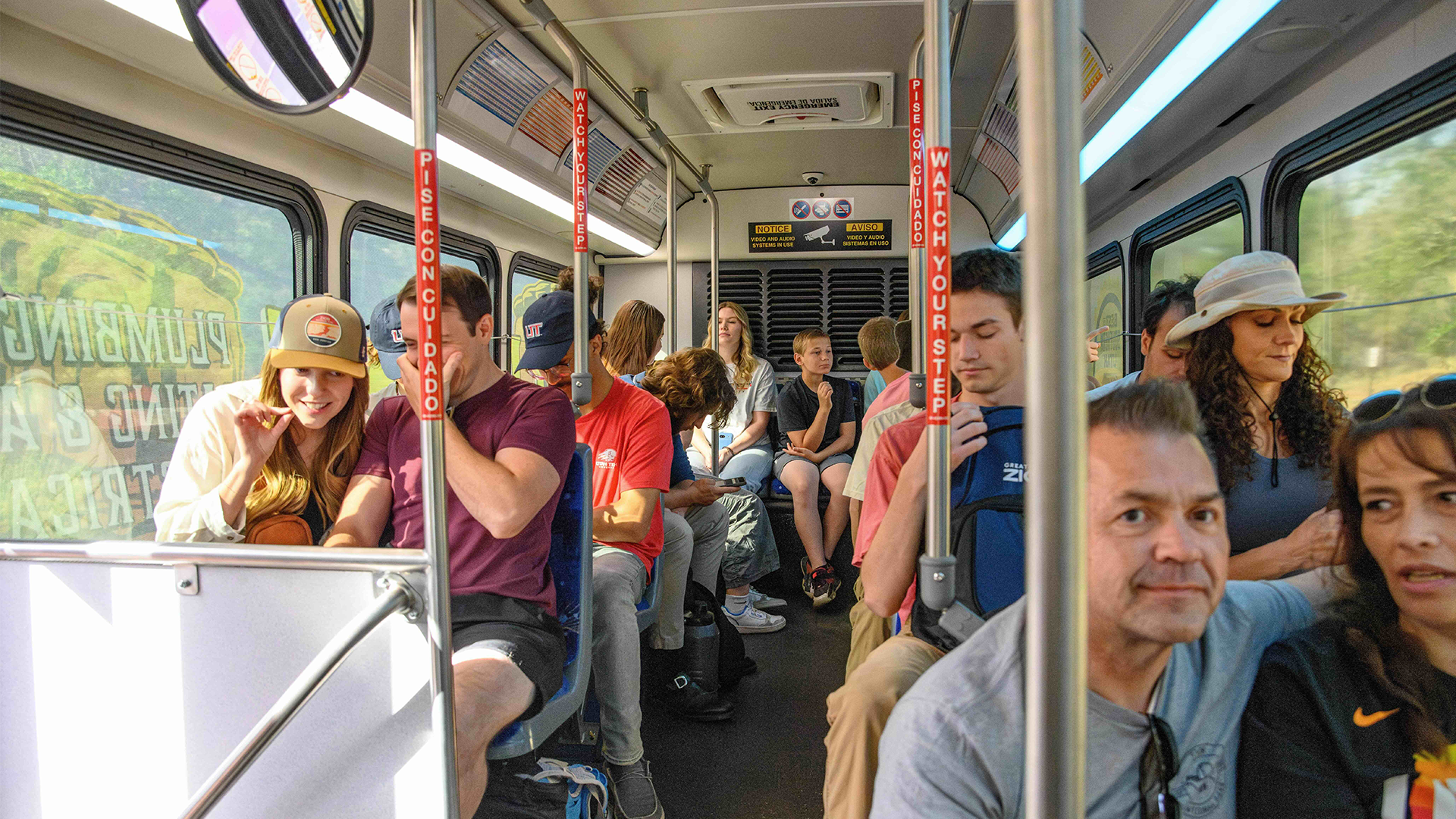
The SunTran Zion Route offers an easy, comfortable way to reach Zion National Park from across Greater Zion. There’s nothing between you and the breathtaking landscape but anticipation.

This paid shuttle runs daily from St. George with convenient stops in Washington, Hurricane, La Verkin, Virgin, and Springdale. You can board the bus at any of the 11 stops and enjoy the journey as the scenery shifts from town streets to towering candy-striped cliffs. 

With wheelchair-accessible buses, space for bikes and strollers, and simple onboard payment options, SunTran makes travel feel effortless. Step off in Springdale, and you’re just moments from food, shops, and the free town shuttle. Or ride SunTran all the way to Zion Canyon Village and enter the park through the Zion Canyon pedestrian entrance.

Learn More

Starting March 1, 2026, the Town of Virgin, in partnership with Zion White Bison Resort and SunTran, will launch the Zion Gateway Park & Ride. This is a space where you can park at the resort and take a shuttle or rode tje bus to Zion National Park. Enjoy a simpler way to navigate restricted roads with a large vehicle; choose to park and ride.”

Touring

Motorcoach companies planning to travel to the park should check out Greater Zion’s motorcoach resources.


Getting Around the Park 

Most visits to Zion National Park involve at least one scenic drive because the park is made up of three distinct sections. Whether you ride, bike, or walk through the park, a valid park pass is required, even in locations without staffed entrance stations. 

Main Canyon (Zion Canyon)

When you envision a visit to Zion National Park, the famous scenery from the Main Canyon is likely what comes to mind. The main and most popular section of the park is accessed from State Route 9. That’s heading eastbound from St. George or Cedar City or westbound when coming from the Bryce Canyon National Park. Two of the country’s most iconic hikes, Angels Landing and The Narrows, are accessed via the Main Canyon, along with other incredible trails. Due to high visitation rates, it is the only part of the park that runs a shuttle to accommodate more visitors and ease traffic. 

Kolob Terrace 

Kolob Terrace is accessible from Highway 9 via Kolob Terrace Road, near the small town of Virgin. Home to the famous Subway hike, Kolob Terrace is approximately 20 minutes away from the Main Canyon. Most of the hiking trails in this section are long, backcountry hikes that are best-suited for advanced hikers with wayfinding skills. The scenic drive on Kolob Terrace Road is a breathtaking experience, especially during the fall months.

Kolob Canyons

This upper section of the park is located off Interstate 15 at exit 40, near New Harmony. Sometimes referred to as Kolob Fingers, it is approximately one hour away from the Main Canyon entrance. Double Arch Alcove on the Taylor Creek Trail and the scenic lookout from Timber Creek Overlook Trail are the highlights of this section of the park.

Roads in Zion National Park


Two roads in the park are accessible to private vehicles: Zion Canyon Scenic Drive and Mount Carmel Highway (State Route 9).

Zion Canyon Scenic Drive is a road that stretches approximately eight miles from the intersection of Mount Carmel Highway to the Temple of Sinawava, passing by Zion Lodge. It provides various access points to some of the best hikes in Zion National Park – including Angels Landing, Emerald Pools, The Narrows, and more. This road is often only accessible by the Zion Canyon Shuttle.

Mount Carmel Highway is another one of the roads in Zion National Park. It is the main road through the park and takes private vehicle drivers through the historic Zion-Mount Carmel Tunnel with access to the Canyon Overlook Trail. It connects the South and East Entrances of the park. Check here for large vehicle restrictions. 

Driving in the Park


Can you drive a private vehicle in Zion National Park? The answer is … yes, but restrictions apply. 

Private vehicles are only allowed onto Zion Canyon Scenic Drive when shuttles are not running, which is a very limited time frame – typically late fall through early spring, with specific dates varying from year to year. But, for the majority of the year, the shuttle is the best (and only) way to travel.

At any time of the year, private vehicles can drive through Zion National Park and the Zion-Mount Carmel Tunnel on SR-9; however, the road is susceptible to congestion, and the tunnel has restrictions for oversize vehicles. Winter road conditions may also warrant temporary closures. The Zion-Mount Carmel Tunnel will be closed to oversized vehicles on June 7, 2026. 

Parking 


Parking spaces inside the park boundaries are limited. Arrive early for the best odds of finding a spot in the Visitor Center parking lot. 

Pro Tip: Observe all signage and park only in designated areas for your safety and the preservation of the park.

An alternative option is to park in Springdale, the town immediately adjacent to the South Entrance of the park. With paid parking lots and spaces available virtually everywhere through town, you can easily walk or take the free Springdale Town Shuttle to the pedestrian entrance in the park. The time you save is worth the parking fee. 

The Zion National Park pedestrian entrance is found in Zion Canyon Village, a public plaza with access to parking, adventure outfitters, groceries, and adventure-fueling restaurants. 

Springdale and Zion Canyon Shuttles 


When it comes to exploring the park, the shuttle is your best friend. It’s convenient; it’s environmentally-friendly; and – best of all – it’s free. There are two different shuttle lines: the Springdale Town Shuttle and the Zion Canyon Shuttle. 

The Springdale Town Shuttle is available for transportation to and from the park, as well as around the town of Springdale. It runs daily, stopping at nine locations in town. Stop 1 at Zion Canyon Village, a public plaza adjacent to the park’s pedestrian entrance, is the best way to enter the park.

This shuttle creates a pleasant, walkable atmosphere in town and allows you to leave your vehicle behind when exploring the stores and restaurants. The only time you need your car is to explore something greater, beyond the park you know.

Springdale Shuttle

March 2 to May 17May 18 to September 14September 15 to November 1
First shuttle leaves Hotel De Novo (Stop 9)8 a.m.7 a.m.8 a.m.
Last shuttle leaves Zion Canyon Village (Stop 1)7 p.m.8 p.m.7 p.m.

The second shuttle line is the Zion Canyon Shuttle. This shuttle helps you navigate within the park. When in operation, the Zion Canyon Shuttle takes visitors from the Zion Canyon Visitor Center to the Temple of Sinawava. There are nine different stops along this route, each providing access to different trails in the park,  including Angels Landing, Emerald Pools, The Narrows, and more. 

Do not wait until the last shuttle to leave for the day. Due to limited capacity, the shuttle may be full by the time it reaches your stop, and you will be stuck making the eight-mile trek back to the Visitor Center on foot.

Zion Canyon Shuttle

March 2 to May 17May 18 to September 14September 15 to November 1
The first shuttle leaves the Zion Canyon Visitor Center (Stop 1)7 a.m.6 a.m.7 a.m.
Last shuttle leaves the Visitor Center to the Temple of Sinawava (Stop 9)5 p.m.7 p.m.5 p.m.
Last shuttle out of the canyon from the Temple of Sinawava (Stop 9)7:15 p.m.8:15 p.m.7:15 p.m.

For the most up-to-date shuttle information, visit the National Park Service’s Zion National Park website

SunTran Zion Route

Experience Zion with unprecedented ease on the new SunTran Zion Route, connecting St. George to the park with convenient stops in Washington, Hurricane, La Verkin, Virgin, and Springdale. Running daily from 5:40 a.m. to 8:30 p.m., this paid shuttle service liberates you from parking woes and traffic stress, delivering you directly to the doorstep of Zion’s towering cliffs, emerald pools, and winding slot canyons. Simply step aboard in St. George and step off ready to explore iconic trails like Angels Landing and The Narrows, with nothing between you and the breathtaking landscape but anticipation.

Map & Travel Guides

These virtual and interactive maps and travel guides provide users with a 360-degree augmented reality experience of Zion National Park while highlighting different areas such as the Mount Carmel Highway, the Canyon Overlook, Big Bend, and the West Rim Trail. With the stunning imagery paired with insightful information about the trails, what you’ll see and the park’s history, it’s truly the next best thing to being there in person.

Zion National Park Maps


Please utilize this map and info sheet (previewed above.)